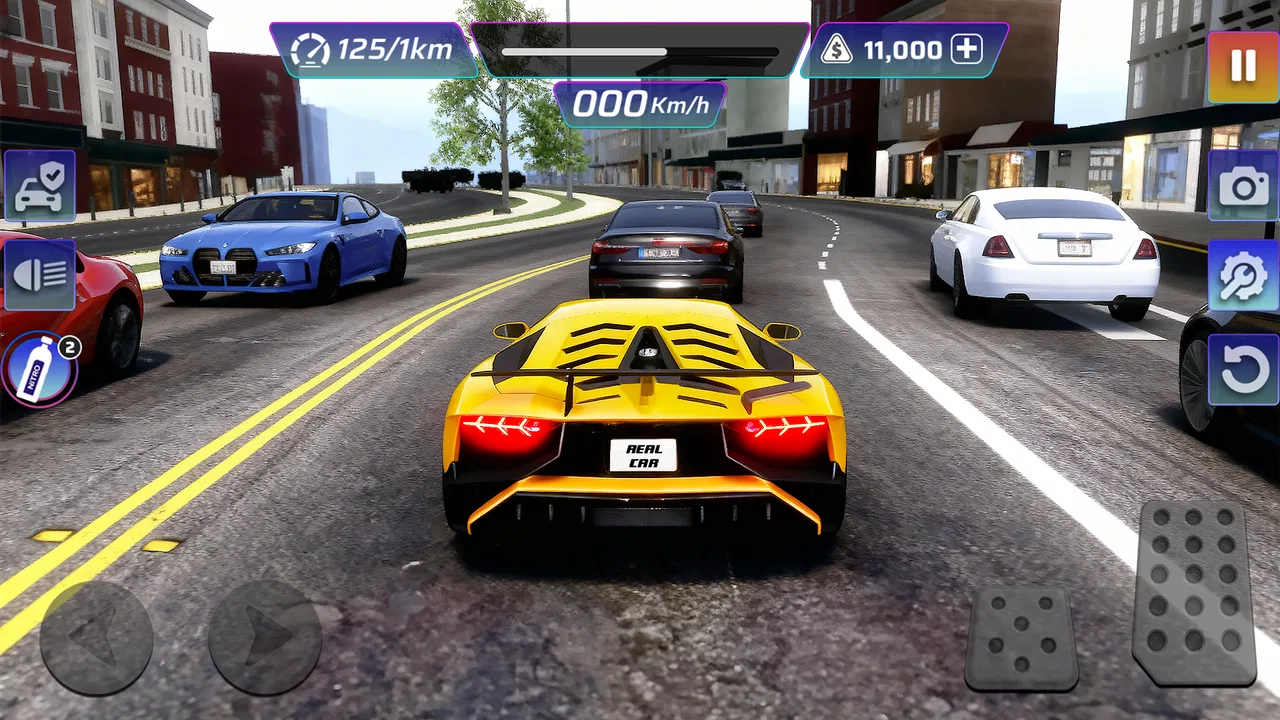
Real Car: Drift Racer 3D
- 4.6
- Rating
- 1.00M
- Installs
- Free
- Price

 Analysis by App-foxy
I approached Real Car: Drift Racer 3D as a quick racing game rather than a large simulation, and that expectation made the first sessions much more enjoyable. It is built around driving, controlled drifting, and city racing, so the appeal is immediate: get behind the wheel, learn how the car reacts, and try to carry a slide without losing the road. I like that the basic idea is easy to understand even if mastering it takes more patience.
This is a free racing game from Tuan Anh Hoang, rated for Everyone. It has reached over 500 thousand installs and holds a 4.8 average from roughly 684 ratings, which suggests that its simple driving focus has connected with a sizable audience. The current release is version 1.0.1, and it works on Android 7.0 or later. Those details make it approachable for people using older compatible phones, although the visual style and handling will still feel more comfortable on a device with a responsive screen.
What the first drive is really like
The first thing to understand is that this is not the kind of racing game I would choose for a deep career structure, licensed competition, or a long list of management systems. Its strongest idea is the moment-to-moment driving. You are asked to pay attention to steering, speed, corners, and the timing of a drift. That gives the game a direct rhythm: approach a turn, adjust your line, begin the slide, and try to exit without overcorrecting.
You May Also Like

 Blood Strike: 2.5 Anniversary
Blood Strike’s Loadouts Turn Every Drop Into a Tactical Gamble
A close look at Blood Strike’s custom loadouts: how fast access to signature weapons reshapes its battle royale rhythm, rewards preparation, and narrows the gap between fights.

 Pandora - Music & Podcasts
Pandora’s Music Is Easy to Start, but Harder to Recover
Pandora’s strength is its low-effort path from a seed to a station. Its weak spot is how much confidence it asks you to place in connection, setup, and quiet recovery.

 8 Ball Pool
 Is Built on Rivalries, Rematches, and Routine
A close look at the rivalries, rematches, shared routines, and unanswered safety questions that turn a quick pool match into a persistent mobile community.

 Samsung Music
’s Quiet Strength Is Playing What You Already Own
Its reach comes less from spectacle than from dependable access to a personal library. That simplicity is both the app’s strongest retention engine and its ceiling.

 AccuWeather: Weather Radar
AccuWeather Review: A Quick, Clear Forecast for Everyday Decisions
For everyday plans, the best forecast is the one you can understand quickly. AccuWeather makes rain timing, radar, and local conditions easy to act on, with a few trade-offs.

 Hill Climb Racing
Why Hill Climb Racing Still Turns Crashes Into One More Run
A tiny car, a bumpy hill and one more upgrade: Hill Climb Racing keeps resurfacing because its simple chaos makes every near-miss feel personal.
More From Our News Desk
View All News


That simplicity is useful for a first-time player. I did not need to learn a complicated menu structure before understanding what the game wanted from me. The store summary points to real cars, smooth drifting, and city routes, and those three elements describe the experience more accurately than a promise of a full racing career would. The attraction is the feel of making a clean turn, not collecting a huge amount of background content.
The city setting also changes how I think about speed. On a straight section, it is tempting to hold the accelerator and treat every corner as an obstacle to survive. That usually makes the next turn harder. A better approach is to see the road as a sequence of decisions. Slow slightly before the bend, aim toward the open side, and use a short, controlled slide rather than trying to keep the car sideways for as long as possible.
The first meaningful success is not the longest drift; it is a controlled corner that ends with the car pointed in the right direction. That distinction matters because beginners often chase spectacle and then lose all their momentum. In this game, a modest drift that keeps you on the route is more useful than an impressive-looking slide that sends you into a wall or forces a complete recovery.
Setting up without overthinking it
After installing the game, I recommend giving yourself a quiet first session instead of opening it while distracted. Racing controls depend on small movements, and a crowded commute or a cracked screen can make the handling seem worse than it is. Hold the phone comfortably, keep both thumbs available if the control layout calls for it, and avoid judging the game during the first few turns.
There is no reason to begin by chasing the fastest possible run. The better first setup is mental: decide that the opening attempt is for learning the car’s response. Notice how quickly steering changes the line, how much room the vehicle needs to turn, and how early you need to prepare for a bend. These observations are more valuable than an early result because they give you a repeatable method for the next attempt.
Because the game requires Android 7.0 or newer, compatibility should be straightforward for many Android users. Still, an older compatible phone may not provide the same touch response or visual smoothness as a newer one. If the screen feels delayed, test your steering with very small movements before blaming your technique. A racing game can feel unpredictable when the real problem is an unresponsive display or a device struggling with the scene.
The free price makes experimentation easy, especially if you want a short driving game without committing to a purchase first. I would nevertheless approach it as a focused experience rather than assuming that free means it will replace every other racing game on your phone. Players who want a broad collection of modes should keep their expectations measured. Players who mainly want to practice city corners and drifting can start with much less preparation.
How to reach the first clean corner
For a first attempt, choose a visible corner and treat it as a three-part exercise. First, approach it in a straight line rather than turning too early. Second, reduce your speed enough that the car still has room to change direction. Third, begin the drift only when you have a clear exit in mind. If the car starts sliding toward the outside barrier, release the input that is making the slide larger and guide the vehicle back toward the road.
This sounds basic, but it solves the most common beginner mistake: trying to create a drift before understanding the turn. I found it more helpful to practice one corner repeatedly than to race through a whole route while making random corrections. Once the same bend begins to feel predictable, the next corners become easier because your hands have learned the timing.
A useful habit is to look beyond the front of the car. Instead of staring at the immediate road, focus on where you want the vehicle to be after the corner. That naturally discourages late steering. It also helps you decide whether a longer slide is actually useful. If the exit is narrow, a short drift is usually safer. If the road opens up, you have more room to let the car rotate.
My first recommendation for new players is therefore simple: aim for consistency before speed. Finish several corners without panic, then begin shortening your braking or increasing your entry speed. This creates a clear path from installation to progress without requiring advanced knowledge. Every improvement becomes visible because you can compare one decision with the previous one.
Why drifting feels different from ordinary steering
Many casual racing games let you steer through corners with little consequence. Here, the drift is the part that gives the driving its identity, but it also creates the largest learning curve. A drift is not just a decorative movement. It changes the direction of the car and reduces the amount of grip available for a clean exit. If you start it too early, you may spend the entire bend trying to recover.
I recommend using short inputs while learning rather than holding a direction continuously. Small corrections make it easier to feel whether the car is beginning to rotate or already sliding too far. This is one of the less obvious ways to improve: do not treat the controls like an on-and-off switch. Think of them as a conversation with the car, with each adjustment answering the previous movement.
Another helpful technique is to separate entry, rotation, and exit in your mind. Entry is about arriving at a manageable speed. Rotation is where you allow the car to turn and slide. Exit is where you stop asking for more angle and concentrate on pointing down the next section. Beginners often continue rotating after the car has already reached the correct direction, which turns a successful drift into a spin or a wide escape.
The game is most satisfying when these stages start to blend together. A corner that initially felt like a sequence of emergency corrections can become one smooth action. That is where the title earns its place as a drift-focused racer, even without relying on complicated systems. The reward comes from improving your control, not merely from unlocking another menu item.
Confusion that can make the game seem harder
The biggest source of confusion for a new player is the difference between going fast and driving well. A high-speed approach may feel exciting, but it leaves less time to correct the car. If you repeatedly hit the outside of a turn, do not immediately assume that the route is unfair. Try entering more slowly and beginning the drift later. A slower corner can produce a faster overall run if it avoids a complete loss of momentum.
It is also easy to mistake a long drift for a successful drift. Length alone is not a useful target. The more important questions are whether the vehicle stays on the road, whether it faces the next section, and whether you can continue without a large correction. This is why I would not copy dramatic drifting clips from other games and expect the same approach to work here. The city environment rewards control and awareness more than exaggerated movement.
Another common misunderstanding is expecting the car to behave like a real-world vehicle in every detail. The game uses the language of real cars, but it remains an accessible mobile racing experience. Its handling should be judged by responsiveness and enjoyment, not by whether every tire reaction matches a professional simulator. If you want exact mechanical modeling, a dedicated simulation would be a better choice. If you want a lighter way to practice slides on a phone, this approach is more welcoming.
When a run goes badly, I suggest changing one variable at a time. Lower your entry speed first. If that does not help, adjust when you begin steering. Then try making the drift shorter. Changing everything at once makes it impossible to know what fixed the problem. This small troubleshooting method is especially useful for first-time players because it turns frustration into a practical experiment.
Using short sessions as a real advantage
I can see this game fitting naturally into a short break. Imagine waiting for an appointment with only a few minutes available. Rather than starting a complicated campaign that demands a long commitment, you can use the time to practice one city section or repeat a difficult corner. The session still has a clear purpose, and you can stop after a clean run instead of feeling that you abandoned a larger task.
Short sessions are also useful for improving technique. Spend one attempt watching the road and ignoring your result. Spend the next concentrating on speed before the corner. On another attempt, focus only on the exit. This turns casual play into structured practice without making the game feel like homework. The approach is particularly effective when your problem is inconsistent timing rather than a lack of enthusiasm.
For younger players, the Everyone rating and straightforward racing premise make the game easier to introduce than a title built around mature themes. I would still encourage an adult to try the controls first if the game is being installed for a child, because the important question is not only age suitability but also whether the driving feels comfortable on that particular device.
The same short-session strength can be a weakness for someone seeking a deep long-term hobby. If your ideal racer includes extensive tuning, detailed vehicle statistics, online competition, or a large progression map, this may feel too narrow. The game is better suited to a player who values immediate driving and wants to improve through repetition.
How it compares with other racing choices
Compared with arcade racers that emphasize boosts, stunts, and constant spectacle, this game puts more attention on the corner itself. You are less likely to win through frantic tapping alone. That makes it a good alternative when you want the car’s movement to matter, but it may feel restrained if you prefer explosive effects and a nonstop sense of escalation.
Compared with serious driving simulators, it is easier to approach and less demanding in its presentation. You can focus on the basic relationship between speed, steering, and drifting without first learning a large set of vehicle settings. The trade-off is depth. A simulator will usually satisfy a player who wants detailed adjustments and technical accuracy more than a compact drift racer can.
It also differs from endless racers that mainly ask you to avoid obstacles for as long as possible. The city-road focus gives each turn more importance, so I would choose this game when I want to practice decisions rather than simply react until the run ends. On the other hand, someone who enjoys an endless score chase may prefer a game designed around continuous distance and rapid lane changes.
The most suitable comparison is therefore not “which racer is best?” but “what kind of driving mood do I want?” Choose this one for direct drifting practice, approachable city driving, and quick attempts. Choose a larger racing game when you need a broad collection of cars, events, or progression systems. That distinction prevents disappointment and makes the game’s focused design easier to appreciate.
Who should install it, and who should skip it
I would recommend it to a first-time mobile racer who wants to understand drifting without being buried in menus. It is also a good fit for players who enjoy repeating a corner until their timing improves, and for anyone looking for a free game that can be played in compact sessions. The high average rating and large install base show that the simple formula has found an audience, although those figures should not replace your own judgment about the style of racing you enjoy.
I would be more cautious about recommending it to someone who needs a detailed simulation. If you want realistic setup work, highly technical vehicle behavior, or a long competitive structure, another racing title will likely serve you better. The same applies if you dislike repetition. Much of the satisfaction here comes from practicing the same driving ideas until they become natural, so a player who expects constant novelty may lose interest sooner.
Device age is another practical consideration. Android 7.0 compatibility opens the door to older phones, but compatibility does not guarantee an equally smooth experience on every handset. If your phone already struggles with 3D games, the driving may feel less precise than intended. I would test a few corners before deciding whether the game’s handling suits you.
The next step after the first success
Once you can complete a corner cleanly, do not immediately try to double your speed. Link two corners together. The first should end with the car positioned for the second, which teaches you to think about the route rather than treating every turn as an isolated challenge. This is where the game becomes more interesting: a good drift is no longer just a visual moment, but preparation for what comes next.
After that, create a personal rule for each session. You might aim to reduce one correction, hold a cleaner line, or finish a route without touching the outside of a turn. These goals are more useful than chasing an undefined idea of perfection. They also make progress easier to notice, especially when you are playing in short bursts.
Keep the current release in mind as well. Version 1.0.1 presents the game as a relatively focused experience, so I would evaluate it on the driving available now rather than expecting it to behave like a mature, content-heavy racing platform. That is not necessarily a flaw. It simply means the value is concentrated in the core activity: getting better at guiding the car through city roads.
My final impression is positive, with a clear qualification. Real Car: Drift Racer 3D works best when you want a straightforward, free drifting game and are willing to learn through repetition. Its strongest moment is the clean corner that you could not manage a few attempts earlier. It is not the right pick for deep simulation fans or players demanding a huge racing ecosystem, but for a newcomer looking for an approachable path from the first drive to genuine control, I think it is worth trying.
FAQs for Real Car: Drift Racer 3D
01What are the main features of Real Car: Drift Racer 3D?
Real Car: Drift Racer 3D offers realistic physics, stunning 3D graphics, and a variety of customizable cars. Players can enjoy multiple game modes, including time trials and multiplayer options. The game also features dynamic weather conditions and detailed tracks, enhancing the immersive racing experience for users.
02Is Real Car: Drift Racer 3D free to play?
Yes, Real Car: Drift Racer 3D is free to download and play. However, it includes in-app purchases for various items such as car upgrades and cosmetic enhancements. While these purchases can enhance gameplay, they are not necessary to enjoy the core experience of the game.
03What devices are compatible with Real Car: Drift Racer 3D?
Real Car: Drift Racer 3D is available on both Android and iOS platforms. It is compatible with most modern smartphones and tablets. To ensure optimal performance, your device should meet the minimum operating system requirements and have sufficient storage space available for installation.
04How can I improve my drifting skills in the game?
Improving drifting skills in Real Car: Drift Racer 3D requires practice and understanding of the game’s physics. Start by experimenting with different cars and tracks to find the best combinations. Adjusting your car’s settings and practicing on various difficulty levels can also help refine your drifting technique over time.
05Are there any multiplayer options in Real Car: Drift Racer 3D?
Yes, Real Car: Drift Racer 3D offers multiplayer options where players can compete against others worldwide. This feature adds a competitive edge to the game, allowing you to race against friends or challenge random opponents. Make sure your internet connection is stable for the best multiplayer experience.
Pros
- Realistic physics enhance gameplay immersion.
- Wide range of cars to choose from.
- Detailed graphics for a mobile game.
- Intuitive controls suitable for all players.
- Regular updates with new tracks.
Cons
- In-app purchases can be pricey.
- Occasional lag on older devices.
- Limited customization options.
- Ads can be intrusive during gameplay.
- Requires a stable internet connection.

Real Car: Drift Racer 3D
Gallery